Rusted Steel Stairs & Handrails: Rusted Handrails: Repair, Repaint, or Replace?

Updated: Sep 2
Rusted stairs and handrails are common maintenance issues on exterior facilities. The important question isn't simply whether rust is present—it's what is happening beneath and around the coating.
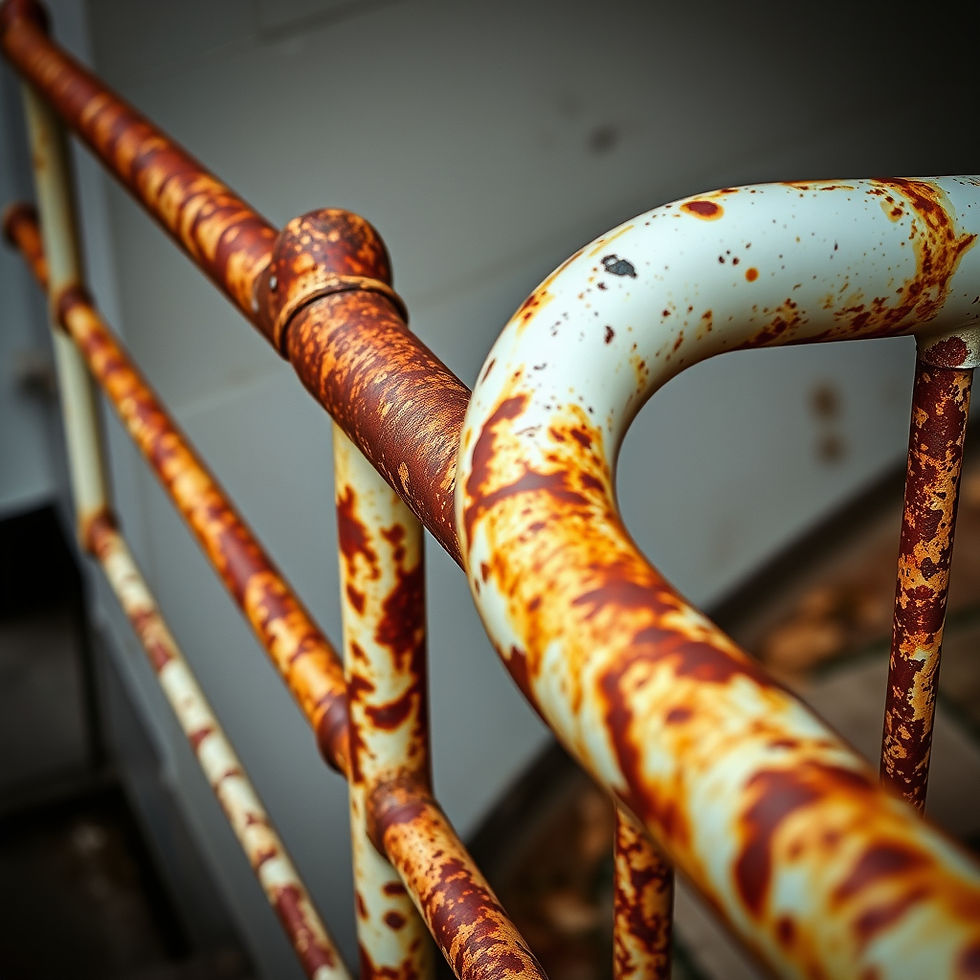
Steel stairs and handrails are exposed to repeated wetting, humidity, UV exposure, abrasion, and contaminants. Over time, protective coatings can deteriorate and allow corrosion to develop.
A proper maintenance decision starts with understanding the condition of the coating and the condition of the steel.
Look Beyond the Rust
Not all corrosion indicates the same level of deterioration.
During an inspection, look for:
Surface rust and staining
Peeling, cracking, or delaminating coating
Bare steel
Corrosion around welds and edges
Rust at connections and fasteners
Corrosion at base plates
Heavy rust scale
Pitting
Section loss or deformation
The location matters. Edges, welds, crevices, and connections can be particularly vulnerable because coatings are often thinner or more difficult to apply uniformly in these areas.
Coating Failure vs. Steel Deterioration
This is one of the most important distinctions in a maintenance project.
If the steel is generally sound and the problem is primarily deteriorated coating and surface corrosion, a maintenance recoating project may be appropriate.
If corrosion has resulted in significant pitting, section loss, perforation, deformation, or other evidence of compromised steel, coating alone may not address the problem.
Where structural deterioration is suspected, an appropriately qualified professional should evaluate the condition before coating work proceeds.
Surface Preparation Determines What Happens Next
A new coating cannot reliably compensate for inadequate surface preparation.
Depending on the existing condition and specified coating system, preparation may involve:
Cleaning
Removal of loose coating
Hand-tool preparation
Power-tool preparation
Abrasive blasting
Removal of corrosion products
Feathering existing coating edges
The required preparation level should be established based on the condition of the substrate and the requirements of the coating system being applied.
The goal isn't simply to make the steel look clean.
The surface must be prepared to provide an appropriate foundation for the new coating.
Pay Attention to Edges, Welds & Connections
Localized failures often occur in areas that are difficult to coat consistently.
Welds, sharp edges, bolts, connections, and transitions can experience accelerated deterioration when moisture reaches the substrate or coating thickness is insufficient.
These areas deserve particular attention during preparation and coating application.
Don't Ignore Slip Resistance
A stairway can have a sound corrosion-protection system and still present a maintenance concern if the walking surface becomes slippery when wet.
For appropriate applications, an anti-slip system or compatible aggregate can be incorporated into the coating system to provide additional traction.
The appropriate system depends on the use, exposure, substrate, and project requirements.
How Do You Decide Between Spot Repair and Full Recoating?
A maintenance project should be based on the overall condition of the asset, not simply the worst-looking spot.
Spot Repair
May be appropriate when deterioration is limited and the surrounding coating remains well adhered and serviceable.
Partial Recoat
May make sense when multiple areas have deteriorated but significant portions of the existing system remain suitable.
Full Recoat
May be appropriate when coating failure and corrosion are widespread or when the existing coating system no longer provides an acceptable foundation for continued maintenance.
The final approach should consider the existing coating, substrate condition, exposure environment, surface preparation requirements, and specified coating system.
The Bottom Line
Rust is a symptom—not the entire diagnosis.
The right maintenance approach depends on whether the problem is primarily coating deterioration, surface corrosion, or deterioration of the steel itself.
A good coating maintenance project starts with understanding the asset, documenting its condition, preparing the surface correctly, and selecting a coating system appropriate for the environment. For facility managers, identifying deterioration early can provide more options for maintaining an asset before corrosion becomes a larger repair problem.
Summit Painting Contractors LLC provides steel coating, corrosion maintenance, surface preparation, and anti-slip coating services for facility maintenance projects.
Have a Rusted Stairway or Handrail?
This article is provided for general educational purposes only. It is not a structural inspection, engineering evaluation, coating specification, or determination of structural adequacy. Project requirements depend on site conditions, existing materials, applicable specifications, coating manufacturer requirements, and qualified professional evaluation where appropriate.


Comments